

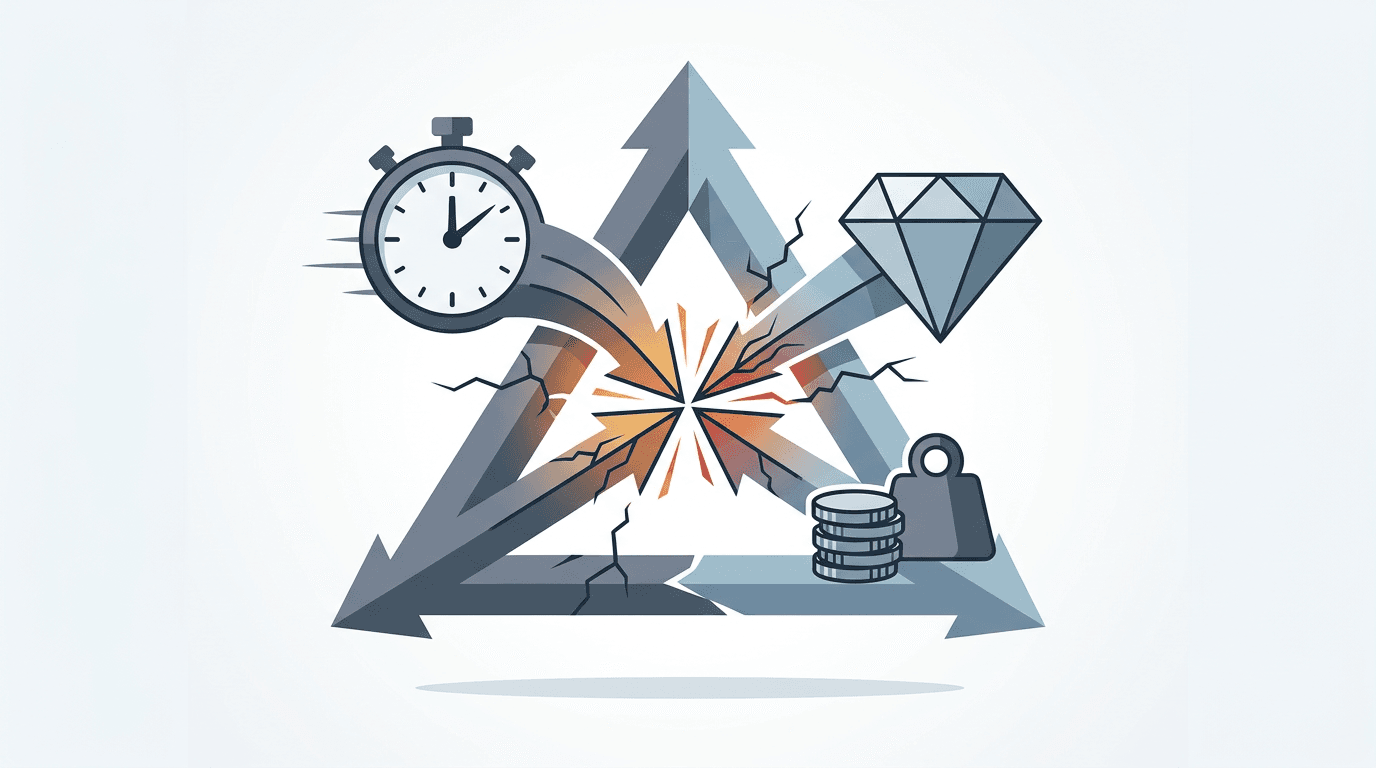
Every research operations leader has been in this meeting.
The business wants more studies, faster turnaround, and wider coverage. Finance wants lower cost per project. The quality team wants zero fielding errors. And you're sitting there with the same headcount you had last year, wondering which of these three constraints you're going to violate first.
This is the researcher's dilemma. It's not new. But in 2026, it's sharper than ever.
The quality floor is non-negotiable
Research has a quality problem, and the industry knows it. The 2025 GRIT Insights Practice Report flagged sample quality as a top concern. Data integrity failures don't just waste budget — they erode the trust that insights teams have spent years building.
A survey that goes to field with broken skip logic doesn't produce bad data. It produces confidently wrong data — the kind that looks clean in a cross-tab but leads to decisions based on responses from people who should have been screened out.
When a client discovers a routing error after fielding, the cost isn't just the refield. It's the conversation where you explain that the numbers they've been presenting to leadership are unreliable.
Quality isn't a nice-to-have. It's the entire point.
The speed ceiling keeps rising
At the same time, the pressure to move faster has never been more intense.
Greenbook's New Insight Playbook for 2026 describes the dynamic precisely: "Last-minute requests. Impossible timelines. Insights that don't ultimately influence decisions. Research relegated to a reactive function and treated as a validation service instead of a strategic partner."
This creates a vicious cycle. When research is slow, stakeholders route around it — making decisions without data, or commissioning quick-and-dirty alternatives. When the insights team does deliver, the findings arrive too late to influence the decision. Which reinforces the perception that research is slow. Which leads to tighter timelines next time.
The only way to break the cycle is to actually be faster — not by cutting corners, but by eliminating the steps that don't require human judgment.
The cost vise
Budgets are flat or shrinking. A McKinsey study on AI's workforce impact shows headcount pressure across knowledge-work functions adjacent to insights. Research teams are expected to absorb more work without proportional investment in people or tools.
The math is simple and unforgiving: if your cost per project stays constant and your budget stays flat, your project count stays flat. If stakeholders expect more projects, something has to give.
For most teams, what gives is either quality (faster but sloppier) or morale (same quality, but the team burns out). Neither is sustainable.
The wrong response: automate everything
The temptation is to throw AI at the entire workflow and hope for the best. Automate design, automate programming, automate analysis, automate reporting. Reduce the human to a supervisor reviewing machine output.
This doesn't work — at least not uniformly. Some parts of the research workflow benefit enormously from human judgment. Questionnaire design requires understanding the business question, the target audience, and the cultural context. Analysis requires knowing which findings are surprising and which are noise. Stakeholder communication requires empathy and politics.
Automating those steps doesn't save time — it produces generic output that still needs human rework.
The right response: automate the mechanical layer
The parts of research that benefit most from automation are the ones that are:
- High effort, low judgment: Translating a questionnaire spec into platform-specific code. Running through every path in a survey to verify logic. Reformatting the same data for different client templates.
- Error-prone and tedious: Checking that skip logic references are valid. Verifying that piped text resolves correctly. Ensuring that quota conditions don't conflict.
- Repeated across every project: The same types of questions, the same validation checks, the same deployment steps.
These tasks don't require creativity. They require accuracy and speed — exactly what AI excels at.
When you automate the mechanical layer, the human layer gets better, not thinner. Researchers spend their time on design and interpretation. QA shifts from "click through every path manually" to "review the validation report." Revision cycles shrink because the first draft is cleaner.
What the numbers look like
A research team running 20 studies per month, each requiring 10 hours of programming and 4 hours of QA, spends 280 hours per month on mechanical work. That's roughly 1.75 full-time employees dedicated to translation — not research.
If programming drops to 30 minutes per study and QA is partially automated, those 280 hours become 30. The team doesn't need fewer people — they need the same people doing higher-value work.
That's how you do more with less without sacrificing quality. Not by squeezing the team harder, but by removing the work that shouldn't have been manual in the first place.
The dilemma dissolves
The researcher's dilemma — speed vs. quality vs. cost — only exists when the mechanical work is manual. When it's automated:
- Speed increases because programming and QA happen in minutes, not days
- Quality improves because validation is systematic, not dependent on a tired programmer catching every edge case
- Cost per project drops because the expensive human hours go to the parts of research that actually need them
The dilemma isn't a tradeoff to manage. It's a symptom of outdated tooling.
Questra automates the mechanical layer of survey research — programming, validation, and multi-platform deployment — so your team can focus on the work that requires human judgment. See how it works.